Sunday, February 2, 2020

Gulling at the Wetland Centre


After failing to connect with the juvenile Iceland Gull yesterday at Beckton Creekmouth I decided to try for the adult at the London Wetland Centre. It was a bit of a gamble as it’s been quite erratic in its appearances but it did show mid-morning on Saturday so it seemed worth trying for. It meant I could have a leisurely stroll rather than chasing around all over London which I did yesterday, also I didn’t need an early start to get there for opening time at 9:30.

As I headed for the South Route upon arrival my plan was to slowly wander around but I bumped into fellow Brent birder Shailesh who volunteers at LWC and he told me the Iceland Gull was showing at the WWF hide so I hot-footed it straight there. And a couple of minutes later I was watching a smart adult Iceland Gull, only the second one I’ve seen in London. It was initially on a distant spit but it decided to fly around and land at the front of the closest island so we all had superb views.

Iceland Gull

Iceland Gull with Common Gull behind

Iceland Gull


Someone mentioned a Yellow-legged Gull so I scanned through the other gulls and instead found an adult Caspian Gull. 
Caspian Gull

Caspian Gull with Herring Gull behind on left


After a while all the gulls took up and flew off towards the observatory just before a few other birders arrived including Shailesh. While they went back to look for the gull flock I carried on to the Peacock Hide. From the top deck I could see the Iceland Gull in the distance so hopefully everyone managed to catch up with it. A little later I picked it up flying our way and it landed on the grazing marsh. As I watched it again I noticed a Yellow-legged Gull a bit further back and got everyone on that. It was a very productive gull morning with seven species and only Great Black-back missing from the more common species.
Yellow-legged Gull on right with Lesser Black-backed Gull on far left and Herring Gull in centre


A Bittern was claimed but I couldn’t locate it before it disappeared back into the reedbed. The water level on the marsh was high so there was no chance of any Snipe there and the only Water Pipit was one I heard flying past. I scanned the hospital and was lucky enough to watch one of the Peregrines fly in and land.

High water levels on grazing marsh


As I rushed in I hadn’t seen many small birds so I went for a slow walk along the return route but it was fairly quiet for birds. It got busier and noisier as I approached the centre but that was from the families so I headed to the cafe for a coffee before heading over to the collection. I don’t usually spend a lot of time looking at the captive birds but the woodlands along the way often add species I haven’t seen earlier. Today it was Jay and Goldcrest and a Green Woodpecker at the Wildside Hide – my daily Yaffle.

Pair of feeding Shoveler

A pair of Shoveler were swimming round in circles stirring up food and there were plenty of Wigeon grazing. 

Wigeon

I was hoping to also add Goldeneye and Mandarin but I couldn’t track either duck down so I called a halt to proceedings and headed off back to the centre. On the way the whole Lapwing flock took up and started flying around. Can you estimate how many there are?

How many Lapwing?

It had been an excellent morning and I was especially pleased to see and photograph the Iceland Gull. And the photo below has the answer.


Friday, January 24, 2020

Testing out the Lumix


Another dawn start at Rainham on Saturday 18th, this time with a new camera in tow. My bridge camera was getting a bit old so I splashed out in the January sales and bought the Panasonic Lumix FZ82 and I was eager to test it out. I had to wait a while as Rainham West was fairly quiet. Down at the barges I at least caught up with my first Dunlin of the year, one of several common birds I hadn’t yet managed to catch up with this year.

Female Kestrel among emerging leaves in January

A close female Kestrel was the first bird I managed to photograph which I was quite pleased with. I later snapped another one near the Butts hide that was completely out in the open. 

Another Kestrel
Fieldfare in fading light

I spent a lot of time looking for the Short-eared Owl that others had seen in the Ouzel field but without any luck so I decided to wait until dusk. Not long after 4pm I saw an owl flying around – but it was one of the Barn Owls, actually the first time I’d seen one hunting at Rainham. It put on a good performance but it was a bit too far and there wasn’t enough light for a photo. It was a good finish to a long day even though I never did see a Short-eared Owl.

Sunday I decided to spend the morning at the London Wetland Centre. My number one target was Bittern but they hadn’t been showing that well recently, however the temperature dropped to freezing overnight and there was just enough ice around to force them out to the water’s edge. I headed straight to Dulverton Hide which is always a likely spot. It only took a couple of seconds to see a Bittern straight out against the reeds but by the time I’d put the scope & tripod up it had slithered back into the reed bed and vanished. I waited a while but a guided group of birders had arrived and it was too noisy for me so I moved on.

With the Bittern safely seen I could take me time wandering around and a little while later I ended up at the Peacock Hide. I spent a lot of time scanning the grazing marsh where a Jack Snipe was seen the day before but without any luck. A couple of Water Pipits were pottering about on the ice and I got several people onto them. A second Bittern was found at the back of the reservoir lagoon and this one stayed there for ages. It was a bit too distant for photos but I was keen to try out the 60x zoom of the Panasonic Lumix to see what it could manage.


Distant Bittern


As expected it was rather pushing it so I concentrated on photographing some closer wildfowl instead.


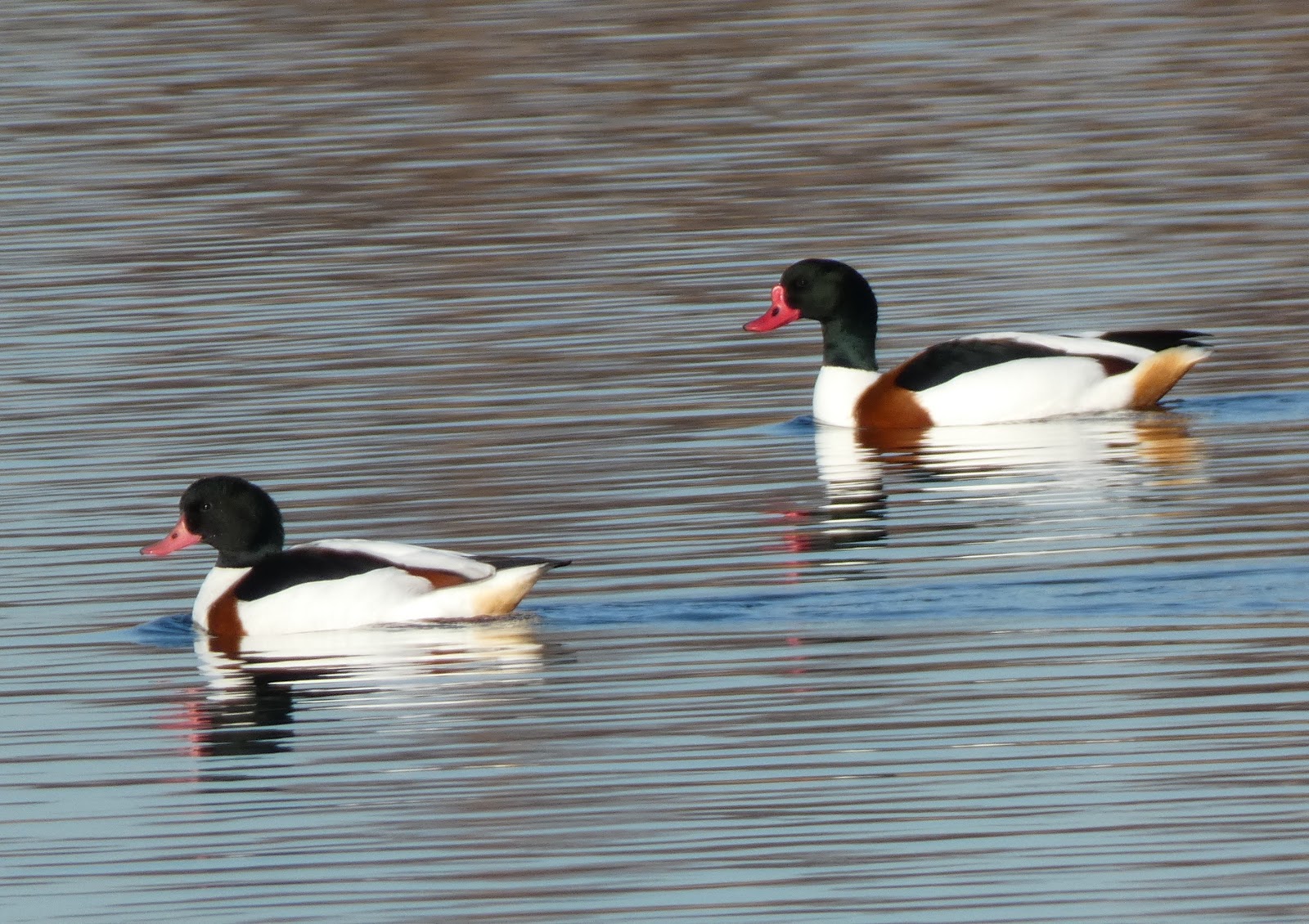
Pair of Shelduck

Pair of grazing Wigeon

Sunday, January 12, 2020

Kicking off the New Year List


The New Year’s list started with a tie – when I opened the window I could hear Song Thrush & Robin singing simultaneously. I added a few more common birds on the way to the station and again while I was waiting on the platform at West Ham for my friends. We’d decided to kick off at Rainham Marsh and the first bird we saw upon our arrival was a Little Egret feeding on the tideline.


Despite there being plenty of exposed mud in Aveley Bay the only waders were a small group of Avocets and a few Redshank. We carried on along the riverwall and soon had both Water and Rock Pipit safely added so we headed onto the reserve. New birds came thick and fast with plenty of ducks, just making sure we saw them all. Two Barn Owls were visible in their box; this is now the easiest owl species to see in London thanks to these reliable birds.

There weren’t many small birds around but we did locate a strange mixed flock from Butts Hide – 4 Bearded Tit, Stonechat and two Chiffchaff with the odd Blue Tit keeping them company in the reeds. Marsh Harrier and Buzzard were both visible beyond the Target Pools while two Ruff did a good job of hiding in amongst the Lapwing but they eventually showed themselves. I finished the day on 66 species, just one fewer than last year’s January 1st visit to Rainham. Well actually I tied that score as well as I heard a Tawny Owl calling outside my bedroom window as I was turning in for the night.

I managed a short visit to Brent Reservoir on 2nd and caught up with a few birds I didn’t get the previous day but on 3rd I was back at Rainham again. This time I started at Rainham West and followed the riverwall along from the Concrete Barges to maximise my chances of finding some new birds. I soon caught up with some fairly common birds I’d missed before like Skylark, Meadow Pipit and Linnet then it was time to scan through the thousands of gulls in the area. I eventually located my target species – Yellow-legged and Caspian Gull, getting an adult and a first-winter of both species.

Lots of water at Rainham Marsh


I took the path over the tip (no Corn Buntings) and surveyed the scene – it was good to see so much water on the marshes after last autumn’s drought. I went through the geese on Wennington but failed to find the White-fronted Goose which appeared a few hours later! But I did see a good number of Rook which were near for the year. A loop of the reserve added a few more new birds such as Water Rail but there wasn’t a Dunlin in sight on the Rainham side of the river.

On Saturday I decided to spend the day in the Lea Valley as it offered the best chance of seeing several new birds for my year list and also it’s a great place that I just don’t visit often enough. I decided to concentrate on the Cheshunt area and took the train there from Liverpool Street. It was barely light when I arrived and I headed towards Seventy Acres Lake. There had been a female Smew seen there the previous day but I didn’t have high hopes of seeing it as Smew are notorious for moving around and there’s an awful lot of old gravel pits here for them to elude birders.

A distant drake Smew


As I walked around the southern edge I could see a distant white bird on the opposite bank which I assumed was a Black-headed Gull but something made me look at it through the bins anyway. And I was pleasantly surprised to discover it was a drake Smew or a ‘White Nun’ in old currency. This has always been my favourite duck so I enjoyed the moment of finding it and then continued to watch it. It swam out of view so I carried on around the path and met it again and pointed it out to another birder who was on her way to look for the Cattle Egrets.

I carried on just beyond the Bittern WatchPoint when I heard a cronking Raven behind me and I could see it flying over Seventy Acres and it landed on a pylon. Another unexpected bird and the first Raven I’d seen in the Valley. I headed northwards towards Holyfield Farm & Lake, picking up a few Siskins and a Treecreeper along the way, the latter being one of the ‘stupid’ birds I missed last year.

Grand Weir Hide overlooking Holyfield Lake

At the Weir Hide I found a female Goosander, the third bird I’d seen today that I failed to connect with last year. More unusually I also found three Red-crested Pochard which I’d guess are quite scarce in the Lea Valley. 

Male Reeve's Muntjac

I retraced my steps, seeing a close Reeve's Muntjac, then popped into the Bittern WatchPoint where I was told there weren’t any Bitterns around at present. I saw the redhead Smew again then carried on down to Hall Marsh Scrape. Only one of the Cattle Egrets was on show, the other had apparently flown off earlier with a Little Egret but one was sufficient and would have been new for my Lea Valley list had I kept one (I started one when I got home!). Another Common Buzzard flew over as I made my way back to Cheshunt station.

One of the Cattle Egrets on Hall Marsh Scrape


The following day I decided to visit Staines Reservoir. It's not one of my favourite birding spots in London, mainly as there's not much to see but there were a couple of good birds I wanted to catch up with. I got the train from Waterloo to Staines, luckily a fast one rather than one that goes all round the houses and arrived at 08:45. There were only a couple of people on the causeway and I'd just missed a good showing of the Long-tailed Duck so I had to put in the hard work to relocate it. 

When this bird is actively feeding it spends at least 95% of its time underwater and with a large area to scan it can take a lot of time to find it. It was about an hour before someone located it on the South Basin and gave me directions. I got on it immediately and watched it dive and surface several times. I'd not seen a Long-tailed Duck in London since the Peckham bird in 2013 so it was nice catching up with this one. Over on the North Basin the flock of 10 Black-necked Grebes only needed a few seconds to locate. This is one of the largest groups I've seen in London. Apart from many Goldeneye on both basins which I also needed for the year there wasn't much else so I called it a day with my London Year List up to 95 species.

Saturday, December 14, 2019

Blowing in the wind


With the shortest day only a week away I got a later train down to Rainham but still arrived at dawn.

Sunrise over Rainham West

The forecast breeze and single figure temperatures suppressed a lot of bird activity and very few Cetti’s Warblers were heard as I walked through Rainham West. As it was low tide I decided to do the long walk via the barges instead of heading along Coldharbour Lane.

When I got to the river a male Peregrine slowly circled around over the gull-less gantry. Perhaps because of the presence of this top predator there were very few waders around, just a small gaggle of Redshank and a solitary Black-tailed Godwit.


As the light wasn't very good for photographing avian raptors I've included a feline one instead.

Despite the wind, raptors seemed to be the order of the day as walked along the Thames with a Kestrel, a female Peregrine and a Merlin all seen within a few minutes over the tip. The Merlin was actively hunting the Starlings, with flocks flying around and splitting up. Unfortunately they disappeared over the other side of the tip so I didn’t see if the Merlin was successful or not.

Just as I approached Aveley Bay an alarm gull made me look up and a gull flew over in panic with two Peregrines flying together behind it. However they ignored the gull and flew straight north. It’s possible these were different birds from the first two birds I encountered so I may have seen four Peregrines. I diverted to the Serin Mound hoping to add some more raptors and a pair of Marsh Harriers were hunting over the reserve but there was no sign of the Common Buzzards that I usually see here.

I scanned Wennington and counted 18 Rook, my highest count here but there could have been more birds present. The weather had deteriorated and there was the odd shower and the wind had picked up considerably. Black skies in the distance made me head to the centre without much delay but I did scan Aveley Bay and apart from a flock of 20 Avocet was surprisingly devoid of waders.

Ominous skies behind Serin Mound
Pylon lit up by a Rainbow

Needless to say the woodland walk was closed due to the winds and there was no chance of any Beardies in this weather so I walked clockwise straight to Butts hide for lunch. The incoming tide had brought many Lapwing and Dunlin in and I managed to find a single Snipe to add to the wader list before calling it a day.

A swirl of Lapwing with a single Dunlin

A Snipe I photographed a week earlier when the light was better
The weather meant it was a struggle finding many of the usual birds such as Stonechat and Reed Bunting but I managed a respectable 65 species which along with the views of the raptors I had earlier still made it a good day.

Friday, November 8, 2019

First frost of autumn


Today was yet another visit to Rainham Marshes. I always enjoy my days off during the week; whilst weary commuters pile off the packed train at Fenchurch Street on their way to work, I board an almost empty train heading back out of London. It finally felt like a change of season today with the first frost of autumn and a distinctly cold feel marking a shift towards the colder days of winter.

Ferry Lane marshes


Autumn is the longest season in the birding calendar beginning in the middle of June (while ‘normal’ people are still looking forward to summer!) when Green Sandpipers first put in an appearance going right through into November. While all the summer visitors have now left, birds are still arriving to spend the winter with us. There was some evidence of migration as there had been arrival of Song Thrushes overnight, particularly along the river wall but nothing was flying over and I only saw one Redwing among the Song Thrushes which were presumably of continental origin. Lots of Robins were setting up their winter territories, some of these may also have flown over the North Sea.

This could either by Ricky - a distant cousin of Rocky - or a Robin from over the North Sea

Down at the Concrete Barges a Fox let me approach closely to take its photo before heading off.


It was almost high tide and a small group of Starlings found a convenient safe place to rest up and preen while their feeding ground was temporarily underwater.

Starlings on the Deep Sea Diver sculpture

Rock and Water Pipits were both seen along the river before I managed my first Meadow Pipit of the day, in fact by the end of the day I had seen more of the first two species which overwinter here than Meadow which is most numerous as a passage migrant.

By the time I reached Aveley Bay the tide was right in and there wasn’t a wader in sight. I’d only seen Lapwing and Redshank so far so hoped there would be more roosting on the reserve.

But I’m jumping ahead and before then I diverted to Serin Mound before going to the reserve. On the approach I heard a Brambling call several times but couldn’t actually see it. There were lots of finches, thrushes and Reed Buntings flying around and diving into bushes and a bit further back there was the first of four Stonechat that were around.

Wennington Marshes was finally living up to its name with the first pools of water in the fields since spring. It had attracted hordes of Greylag Geese and a lot of large gulls but I couldn’t find anything interesting among either flock.

Once on the reserve I headed straight for the woodland and walked round very slowly looking and listening for crests in the hope of bumping into one of the Firecrests that were around earlier in the week but I only managed one Goldcrest. A single tagged on to a flock of Lapwing at Ken Barret hide but by the time I got to Aveley Pools there weren’t any waders other than a few Lapwing and I never saw a single Black-tailed Godwit all day.

It started to feel more like a winter’s day than one in late autumn and it remained cold all day so I decided not to wait until dusk to see if any owls came out – I’ll leave that for another day.

Thursday, October 31, 2019

Ducking and Diving


With several days of easterlies forecast I decided to book a day’s leave midweek so I could visit Rainham in the hope of connecting with some interesting birds. An early start got me to Fenchurch Street in plenty of time to purchase my regular bacon roll and coffee prior to boarding the 07:02 to Rainham. It was already light when I arrived thanks to the stupid clocks being put back last weekend and the high cloud and light wind suggested good conditions for visible migration.

As I walked along the cycle path cutting across the marshes from Ferry Lane I saw a few groups of Woodpigeon flew over including several flocks of over 100 but they soon petered out and I only counted a total of 515 along with three Redwing and nothing else. It seems that birds don’t trust the weather forecast either and only start their journeys when the local conditions are suitable.


Despite the lack of vismig it was still a pleasant walk down to the Concrete Barges once I left the A13 flyover behind full of early morning commuters and truck drivers. I was accompanied all the way by the  ever vocal Cetti’s Warblers that hide in the reeds and then shout out as you approach. I crossed over Ferry Lane and headed down the road towards the Concrete Barges and the River Thames. 
Jolly Roger flying over the Concrete Barges
Concrete Barges with Crossness across the river

Start of the Pirate Trail

It’s also the start of the Pirate Trail but no one seems to know why it’s there and who did it. A tight flock of crows appeared over the tip and flew across the river; I suspected they were mobbing a raptor and sure enough there was a Common Buzzard in the throng.
Spot the Buzzard amongst the Crows
It was low tide so there were plenty of waders on the mud, Redshank, Lapwing & Black-tailed Godwits.
Black-tailed Godwits

I often think back to when I first started birding at Rainham, you had to walk all the way along Ferry Lane as there was no path across it and there were no Godwits. In fact there were often no waders at all if there wasn’t any water in the silt lagoons so at least things have changed positively. This stretch of the river is well known for its over-wintering Rock and Water Pipits and I soon found some of each. There's often some around the barges or the bay where the Deep-sea Diver sculpture is.
Deep-sea Diver sculpture

The pipits have only recently arrived back for the season so it was good to re-acquaint myself with their calls: the flatter, almost out-of-tune Rock and the sharper call of Water although they do sometimes emit intermediate calls which could belong to either species!

I then followed the riverside path which goes around the ever increasing landfill tip, Rainham’s version of the dark satanic mills.
Landfill tip

Coldharbour Lighthouse

The family of black cats that live in the factories along the river wall

At least the tip attracts gulls although today I couldn’t find either Yellow-legged or Caspian among the five common species that are regular here. I stopped at the western end of Aveley Bay to scan the waders on the shore and picked up the usual flock of Avocet, another relatively new comer that winters here. While scanning the river I picked up four large all dark ducks heading east – Common Scoter! - a new species for my Rainham list and also evidence of some movement due to the easterly winds.
Wennington Marshes from Serin Mound

Wennington Marshes looking back to the silt lagoons

I made a  short diversion to the Serin Mound to look over Wennington Marshes but it was fairly quiet apart from a single Marsh Harrier so I returned to the river wall and walked down to the centre for a well deserved coffee.
Kerry the Kestrel regularly hunts by Aveley Bay car park

I did a circuit of the RSPB reserve which didn’t take long as the woodland seemed devoid of birds. I paused to see the Barn Owl in its box then carried onto Avelely Pools. A few waders started to arrive as the tide was coming in and a flock of Dunlin landed on the bank as the water was too deep for them. I didn’t linger too long as I had a message that Andy had found two Goldeneye and a Red-breasted Merganser on the river so wanted to get back to look for them. After a quick spot of lunch at the picnic tables I exited via the turnstile and onto the river wall. I soon found the Goldeneye, another Rainham tick and got them in the scope for Howard who was working nearby. He’d just seen the Merg close in so I wandered along until I could see it, the third species of sea duck on the river today – the easterlies had worked after all!

I joined Andy & Howard then waited until the tide had come in fully, there were plenty of waders flying around but no more seabirds unfortunately. I decided to leave at this point with a vague plan of visiting Regent’s Park on the way home as a Red-throated Diver had turned up there. As I had to go past Baker Street anyway I decided that I might as well pop in for a look and soon found the bird asleep by the cafe with two of my friends keeping an eye on it. It didn’t want to wake up so we took advantage of the adjacent cafe. We could see that the diver had woken up so we went back out for very close views, the first diver I’d seen in Inner London and yet another seabird for the day.
Red-throated Diver


Butterflies & Dragonflies of Java & Sumatra

These are some of the butterflies and dragonflies that I photo'd in Java and Sumatra in August 2026. There are a few I've not specif...