Showing posts with label Bird-of-Paradise. Show all posts

Sunday, July 21, 2019

July 13 – Day 17: K17 and back to Port Moresby

We returned to K17 to start our last full day’s birding. There were plenty of pigeons and parrots feeding in a fruiting tree along with a Grey-headed Cicadabird. 

Pink-spotted Fruit-Dove

We tried to tape lure in a Blue Jewel-babbler but it only remained in view for a split second before disappearing back into the forest. We paid another visit to the King BoP and he was much more cooperative today, even sitting out in the open, albeit not for very long. 

King Bird-of-Paradise

We passed the spot where Sir David Attenborough was hoisted into the canopy to watch displaying Reggiana and Greater BoPs for one of his documentaries. Back at the entrance, two Grey-headed Goshawks flew around and landed in a close tree.

It was soon time to leave the area and we headed back to the hotel to checkout before making our way to Kiunga Airport for a two hour flight back to Port Moresby. Surprisingly for Air Nuigini it left early and arrived ahead of schedule. A quick stop at Dixie’s to check in and drop off our bags and then we made our way up to Varirarta. We only had a couple of hours but it was enough time for one good bird – Barred Owlet-Nightjar at his regular haunt.

Barred Owlet-Nightjar

We returned to Dixie’s for our last evening meal together, unfortunately they don’t have beer and there’s nowhere close to get any. We voted for our Top Five birds and Flame Bowerbird was the ultimate winner.

July 12 – Day 16: Boystown Road & K10

Welcome news at breakfast, England had thrashed Australia in the semi-final of the Cricket World Cup! We returned to the main track while Rockjumper staked out the grassy knoll. It was pleasant weather for birding with sunshine but there wasn’t anything new seen. 

Red-cheeked Parrot

Red-flanked Lorikeet

We did however get great views of a male Flame Bowerbird that twice flew over the track and our first perched Red-flanked Lorikeets and Zoe’s Imperial Pigeon. Two Fruit-Doves in one tree became an Orange-bellied and a Pink-spotted under closer inspection and they were joined by a Crinkle-collared Manucode. Also on the BoP front, one or two female Kings were seen.

A few local boys walked past, one of which was carrying a Cassowary chick, no wonder we hadn’t encountered one anywhere. On that note we left the area and had a quick stop at the airfield to look for pratincoles. We didn’t find any but instead managed great views of a Buff-banded Rail.

Kiunga Airfield - no pratincoles here
Buff-banded Rail

Out again after lunch to a different patch of forest. A Grey-headed Cuckooshrike was new and we saw a female Black Berrypecker on a nest next to the path. A couple of male Greater BoPS were seen but otherwise it was fairly quiet. We stayed to dusk to try for night birds but nothing responded.

July 11 – Day 15: Boat back to Kiunga


Continuing with the early starts it was a little more challenging by torchlight but we were soon tucking into a cooked breakfast. We piled into the boat and motored a short way down the river where we pulled up. 

Twelve-wired Bird-of-Paradise

Atop a tree on the opposite bank sat a male Twelve-wired BoP; it was calling continuously and was looked almost alien with its misshapen head and bizarre tail strands contrasting with its bright yellow body. It remained for about twenty minutes before quietly disappearing into the forest. Continuing on we saw some more Grey Crows and Southern Crowned Pigeons, the latter showing off their bad hair-dos.

Southern Crowned Pigeon
Azure Kingfisher

We walked around a different muddy forest trail and had scope views of both Little and Common Paradise Kingfishers. Back at camp there was a feeding flock of Double-eyed and Orange-breasted Fig-Parrots as well as a perched Doria’s Hawk. Lunch included fried spam for which Kwatu is famous for but there was plenty of choice for those that don’t care for such a delicacy, like various packets of cream-filled biscuits!

Doria's Hawk

We walked to another hide overlooking a bower but its creator, the Flame Bowerbird remained absent during our stay. Fortunately one flew over the river as we headed back to Kiunga on the boat although we really wanted better views of this spectacular orange bird. There were a couple of other new birds on the return journey with two Pacific Bazas and a Dwarf Fruit-Dove seen. 

A rather large dugout on the river

Arriving back at Kwatu, using the boat seats a a makeshift quay

It was nice to get back to civilisation in Kiunga where we could get clean and remove the layers of mud from our clothes and boots. We heard news of a tribal massacre in the Tari area in PNG which was where there’d been trouble last year and it’s remained out-of-bounds since.

July 9 – Day 13: Transfer to Kiunga

As we left Cloudlands Hotel for the last time, the weather was the same as when we arrived, raining. One stop along the way added Dwarf Koel then we went for a walk around a forested area at K17. The target species was King BoP and he was soon located high up in his regular tree, resplendent in his red and white plumage with yellow bill and two short tail streamers. However, he wasn’t a great fan of sitting out in the open!

Many roadsigns are in English and Pidgin, the latter being the most widely spoken language in PNG

This sign is all in Pidgin - can you work out what it means?

We checked into Kiunga Hotel for lunch and then went out to scan a forest edge from a small ridge. It was noticeably hot and sunny, but a pleasant change from the cloudy skies of late. There was a reasonable amount of birds around with Greater BoP and Lowlands Peltops. All too soon it began to rain although we did managed two Papuan Spinetails flying low over the forest and brief views of a group of Papuan Babblers.

July 8 – Day 12: OK Menga and sunshine

Our last full day in the mountains and miraculously it wasn’t raining! The rain held off all morning apart from a brief shower and the birding was easier with more species seen than previous mornings. 

Long-tailed Honey Buzzard taking advantage of the sunshine

We did a section of track at OK Menga starting with another flyover Pesquet’s Parrot and heard the Shovel-billed Kookaburra again. A Greater BoP showed closely as did several Brown Orioles, surely the least impressive members of such a fine family. We popped back down to the river scoring well with Torrent Lark at last and two Salvadori’s Teal behaving just like South America’s Torrent Ducks.

Back on the track an Eclectus Parrot flew over but we still hasn’t seen this relatively common parrot well. A New Guinea Bronzewing belted over and we spent some time unsuccessfully trying to lure a Pheasant Pigeon into view. There were more small birds around with two Longbills seen – Yellow-bellied and Dwarf. The only other new trip bird was a smart, perched Moustached Treeswift.

Moustached Treeswift

Back for lunch at Cloudlands there were now three birding groups as Rockjumper had just arrived. The afternoon bgan with a little light rain but it soon stopped and the sun even dared to appear. We were back on the OK Menga track and there were plenty of birds around, although not always showing. 

Pesquet's (AKA Pesky) Parrot

At least six Greater BoPs were seen including two adult males and a female Magnificent Riflebird flew over, another new BoP for the trip. Parrots of various sorts came and went including four superb Pesquet’s which perched in view for a change. We tried for another 'Shoveler' (Shovel-billed Kookaburra) at dusk which called then flew over unseen. As we finished a Marbled Frogmouth also called but refused to show itself.

July 6 – Day 10: Dablin Creek and OK Menga

Tabubil certainly lived up to its reputation as the rainiest place in PNG. The group we’d met at Kumul had suffered four days of continuous rain (and consequently did little birding) and it started raining first thing and remained so on and off all morning. Despite the weather we still managed to see birds, the highlight being a female Carola’s Parotia. 

Driving to OK Menga, note the sign in English and Pidgin
Low cloud and light drizzle is typical weather here

However we’d managed to see less than ten species before we decided on an early lunch. It seemed like there were more birds in town with Great Woodswallows flying around over the football pitch and a Scrub Honeyeater in the hotel grounds.


The afternoon session was fortunately much drier and we started with a spectacular Golden Cuckooshrike, which seemed most aberrant compared to its monochrome cousins. 

Golden Cuckooshrike

We saw a male Greater BoP, soaring Long-tailed Honey Buzzard, a perched Doria’s Hawk, Pygmy Longbill, more Blyth’s Hornbills, Beautiful Fruit-Dove and a good view of a Pesquet’s Parrot flying over. 

Greater Bird-of-Paradise

Blyth's Hornbill

At dusk we waited for Shovel-billed Kookaburra which finally decided to respond just as we were climbing into the vehicle. We piled out and heard it call from a nearby tree and saw it briefly fly between the branches.

Saturday, July 20, 2019

July 4 – Day 8: Lei River & Hospital

After a leisurely breakfast we visited some different sites today. On our way to the Lei river we chanced upon one of our targets in town, a family party of Torrent Flycatchers. Around the grounds of a hospital we had some Singing Starlings and the first House Sparrows of the trip (!). It was quite a busy site with Rainbow Bee-eaters, Great Woodswallow, Brush Cuckoo and Mountain Myzomela all seen.

Driving along and checking other sites we encountered several raptors: Brown Goshawk, Pygmy Eagle and Brown Falcon. A Papuan Grassbird kept us waiting but eventually showed well. Back at the lodge a Mountain Mouse Warbler walked under the feeding area while the Belford's Melidectes continued to squabble over the plentiful fruit, often chasing the BoPs away.

Belford's Melidectes

Brown Sicklebill

The commonest bird at the feeders was Common Smoky Honeyeater. They have either a yellow or red face patch. We though this was either due to breeding condition or individual colour morphs but I watched one bird's colour change from yellow to red at it was being hassled by a Melidectes and a few birds showed a bit of both colours.

Common Smoky Honeyeater

Common Smoky Honeyeater

Friendly Fantail in the lodge grounds

In the afternoon we went to what looked like someone’s garden with benches, fruiting trees and a view over a clearing in the forest. It proved an ideal location, straightaway we saw Loria’s Satinbird, not as stunning as yesterday’s Crested but still a good bird to connect with. 

The afternoon birding site

There were lots of birds visiting, probably more than we’d seen at any other site, including Rufous-throated Bronze-Cuckoo, Tit Berrypecker, Fan-tailed Berrypecker, King of Saxony BoP, an enormously-tailed Princess Stephanie’s Astrapia, Black Cicadbird and Ashy Robin of the Black-capped race.

Back at the lodge we tried for some night birds before dinner. We walked along a damp trail and stopped at a small clearing where New Guinea Woodcock can sometimes be seen. We heard it call very close behind us and then a bit later a long way down the hillside so our luck was out this time. It was a similar story with Papuan Boobook and Mountain Owlet-Nightjar which were also heard-only.

July 3 – Day 7: Kumul area

Feeling much better after a good night’s sleep and some breakfast I was ready to go birding again. We went in convoy with another birding group that were staying at the lodge to the Lesser BoP site. It was calling regularly when we arrived but not showing. 

The Lesser BoP site

Lesser Bird of Paradise

While we waited there were plenty of other good birds to see such as Magnificent BoP and Greater Lophorina, although both were females, and a Yellow-breasted Bowerbird. Eventually the male Lesser BoP flew across to the tree in front and showed really well, another stunning BoP and considerably better than the females that I saw flypast several times in West Papua.

The next location was the Blue BoP site, which again involved waiting for it to show while we listened to it calling. We did see two male Greater Lophorinas displaying and frustratingly brief views of the Blue BoP. We returned to the lodge for lunch and another session at the feeders with a short break down to the end of the cabins to see a Mountain Firetail, albeit a dull brown juvenile rather than a smart male.

Ribbon-tailed Astrapia at the feeding station

Eastern Crested Berrypecker in the lodge grounds

We returned to the Blue BoP site in the afternoon. While we waited in the garden belonging to the local who protects this bird, a dog suddenly jumped into a bush and a Buff-banded Rail shot out the back! We finally nailed good scope views of the Blue BoP along with Lawe’s Parotia and Mountain Fruit-Dove.

July 2 – Day 6: Yasukom to Kumul

Last night’s awful dinner gave me food poisoning so I skipped breakfast. We packed up and drove back to the track for more birding. Despite not feeling great I still managed to see a few new birds: Grey-streaked Honeyeater, White-shouldered Fairywren, Fan-tailed Cuckoo, Garnet Robin and Black-throated Boatbill. Mid-morning we left the area and drove to the next lodge, arriving in time for lunch.

Kumul Lodge was a refreshing change from the last hotel and is famous for its feeders which attract, amongst others, Birds-of-Paradise. We dumped our stuff, grabbed our cameras and headed to the upper veranda. 

Brown Sicklebill
Ribbon-tailed Astrapia

Within a few minutes we’d seen two BoPs – Brown Sicklebill and Ribbon-tailed Astrapia. Other birds came in regularly to feed on the fruit while other birds fed on the lawn or in surrounding trees, such as Island Thrush, this race looking very like our familiar Blackbird, along with White-winged Robin and Rufous-naped Bellbird.

Island Thrush
White-winged Robin

After lunch we took a rather too energetic trail around the grounds. It obviously hadn’t been walked for a while as a tree had fallen down and completely blocked the path which meant crashing through the undergrowth to rejoin it. And for our troubles, almost the only bird we saw was Papuan Scrubwren. We returned to the feeders until we received news that a pair of Crested Satinbirds were showing in the grounds so we dashed outside to see these rare and stunning birds. 

male Crested Satinbird

Back at the feeders we also saw Brehm’s Tiger-Parrot and Eastern Crested Berrypecker.

male Brehm's Tiger-Parrot

female Brehm's Tiger-Parrot

July 1 - Day 5: Yasukom area again

We left the hotel in low cloud cover; it had rained overnight but it soon cleared. We drove a short distance to a new area known as The Ridge and walked along the main track. This was quite a birdy place for a change. 

One of the first birds seen was a Black Sicklebill which flew over and landed high in a tree then stayed there for ten minutes, occasionally calling. This was the only one we saw all trip so it was great to get such good views. At the same time, a Princess Stephanie’s Astrapia flew over, making up for the one I’d missed yesterday; we later saw another five and several more in the afternoon so this is clearly a good location for them. Our first pigeons for several days were a flock of Papuan Mountain that flew over, which they typically do.

Hooded Manakins

New trip birds were regularly added with Black-billed Cuckooshrike, Regent Whistler, Hooded Manakin, Rufous-backed Honeyeater amongst others. We walked up and down the track before taking a trail into the forest. Here we saw a new BoP, an immature male King of Saxony; it was singing but resembled a female in plumage so wasn’t the view we were hoping for.

We returned to the hotel for lunch; it was already laid out and had clearly been sitting there a while as it was stone cold. The staff obviously hadn’t learnt anything from the visiting chef and need to do a lot better if they want to attract groups to stay there. At least Max had finally arrived, having suffered a repeat performance yesterday of flying out and back to Port Moresby without landing due to the cloud cover.

King of Saxony Bird-of-Paradise

After lunch we returned to the same area and had good views of the exquisite Blue-capped Ifrit and four King of Saxony BoPS – the same prince we saw in the morning, a queen and two distant but cracking Kings complete with twin foot long serrated head feathers. With darkening skies we retreated back to the hotel.

Friday, July 19, 2019

June 28th - Day 2: Varirata


A long day began with breakfast at 5am and subsequent departure up into the foothills of Varirata National Park. Progress was briefly halted at the entrance as there was no one on duty so our driver had to go and find the guard. It was a little after dawn when we made our first stop and as we disembarked from the bus we could hear our first Bird-of-Paradise calling nearby – Raggiana. 

Raggiana Bird-of-Paradise

A short walk into the forest to a viewing area and we were at the lek watching five males calling and displaying although they failed to attract any females. The males spread their impressive tail plumes as they called but didn’t appear to do anything with the two extra long tail spikes. The lek started to quieten down after half-an-hour so we moved on to the next stop at the picnic area where we were treated to a very photogenic Rufous-bellied Kookaburra. 

Pink-spotted Fruit-Dove

Various pigeons either sat at top of distant trees or bombed over, including Pink-spotted, Wompoo and Chestnut-bellied Fruit-Doves and Purple-tailed Imperial Pigeon. Fruiting trees held Mountain, Plain and Mimic Honeyeaters, Hooded Pitohui and the rather silly named Coconut Lorikeet which has never seen a coconut in its life as there aren’t any on New Guinea.
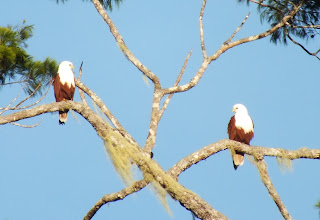
Brahminy Kite

A walk along one trail got our target species of Brown-headed Paradise Kingfisher, the first of three of these spectacular long-tailed kingfishers that we’d encounter on the trip. We also saw Yellow-billed Kingfisher and on other trails added Chestnut-bellied Fantail, Frilled Monarch and Grey Whistler. 

Yellow-billed Kingfisher

The open areas were more productive and included a couple of quality fly-over raptors in the form of Long-tailed Honey Buzzard and Gurney’s Eagle.

Blue-winged Kookaburra

After lunch on the picnic tables we saw Pygmy Drongo, Blue-winged Kookaburra, Black-billed Cuckoo-dove and three species of Cuckooshrike (Barred, Boyer’s and Black-faced). 

Lookout at Varirata

It was sunny for most of the day and quite hot mid-afternoon which subdued bird activity. Nevertheless, we carried on and added a few more birds such as Rainbow Bee-eater, Lemon-bellied Flyrobin, White-throated Honeyeater and Black-capped Lory. Another flyover raptor was Pygmy Eagle and an Azure Kingfisher was seen by most of the group as it dashed by. 

Black-capped Lory

Growling Riflebirds were heard calling but I was lucky enough to spot a female flying across the main picnic site. Our third Bird-of-Paradise was one of the manucodes, a strange black, crow-like BoP, this one being the curiously named Crinkled-Collared Manucode. On one of our last stops we found a roosting Barking Owl which woke up and began calling quietly as it was almost dusk. With that we headed back to Dixie’s to pack up for tomorrow’s departure.

Morocco

The second leg of our Corsica & North Morocco trip with Zoothera Birding began in Casablanca. We landed at 9.30 pm local time, now the s...