Showing posts with label dragonflies. Show all posts

Wednesday, December 3, 2025

India Part 1

This was a private trip to Southern India concentrating on the Western Ghats endemics organised via Bluetail Birding with a short pre-tour extension.

Monday 17th

I met up with Lynne and Neil airside at Heathrow T3 mid-afternoon and we headed for the nearest coffee shop. It wasn’t long before we were boarding our 18:00 Virgin flight to Mumbai. I’d elected for Premium Economy for the extra legroom and the welcome drink of prosecco also went down nicely!

Tuesday 18th

We landed at 08.20 local time in India’s second largest city, home to 23 million people. Black Kite kicked off our trip list with a few seen floating around the airport. Once through immigration we collected our bags and met up with our driver who took us a short distance through the city to our hotel. We couldn’t check in for a while and then decided to rest up for the remainder of the day as we had nothing scheduled.

Wednesday 19th

We had a very early start as we had to drive out of the vast city and northwards to Tansa. We picked up our guide, Prathamesh Desai, at a nearby rail station and arrived at the reserve at 7am having consumed our packed breakfast. The day was all about seeing Forest Owlet but there was time for general birding as well. Green Warbler was heard as soon as we got out of the car and we heard many more during the day and did eventually see one. We taped in a Mottled Wood Owl which flew over the clearing a couple of times being pursued by mobbing Black Drongos and briefly landed where we could see it before disappearing back into the forest.

Mottled Wood Owl with mobbing Drongos


We drove a short distance to the main area for the owlet and one soon started to call. It took a while to get decent views but the pair decided to give themselves up in the end. Also seen in the area were Thick-billed Flowerpecker, Indian Grey Hornbill and Alexandrine Parakeet. We went to a nearby location and saw another Forest Owlet – there are several known territories in the area.

Forest Owlet


With the main target safely in the bag we spent the rest of the day birding the area seeing Rufous Treepie, Indian Golden and Black-hooded Orioles and Grey-breasted Prinia. We stopped at a bridge over a river where several Chiffchaffs (probably Siberian) and a Blyth’s Reed Warbler were feeding. In the sunshine, raptors began to appear and Oriental Honey-Buzzard and White-eyed Buzzard were both seen.

Asian Green Bee-eater

Black Drongo

Indian Golden Oriole

Malabar Woodshrike

White-eyed Buzzard

Yellow-throated Sparrow


We went off for lunch and a rest at the reserve where we were entertained by a family of Peafowl chicks that had been rescued and had soon adopted people as substitute parents, one even climbing up me and falling asleep on my shoulder! 

Reserve entrance - made out of plastic trees!

napping Peafowl chick

We resuming birding the area in the afternoon; it was a lot quieter but we did manage to find Red-headed Bunting, Small Minivet and Cinereous Tit before stopping at 17:30. 

Blue Tigers

Common Sailor

Common Tiger

A couple of unidentified frogs

Large Wood Spider

Slender Skimmer


We dropped our guide back at the station and started the long drive back to Mumbai where the evening rush hour had ground the traffic to a crawl and we didn’t get back to our hotel until 21:15, some three and three-quarter hours later. We had a late dinner then packed for tomorrow’s departure. 

Thursday, July 31, 2025

July birding

July typically sees the true start of autumn migration, especially with waders and this was definitely the case this year. There was also plenty of fine settled weather to look for insects as well.

Rainham Marshes

I've started increasing my visits to Rainham after the midsummer break and went seven times this month. I added two new birds to my London yearlist: a Crossbill heard flying over the woodland and a moulting Ruff that was present most of the month.

Ruff with a Black-headed Gull

Also around on the reserve were five Great Egrets, regularly seen feeding out in Aveley Pools. They appear to be a family party so may have bred in the vicinity.

4 of the 5 Great Egrets

A couple of Green Sands hung around but there was no sign of the hoped for Wood Sand so that'll have to wait for next month. Black-tailed Godwits streamed back in decent numbers, mostly still sporting their summer dress.

Black-tailed Godwits

Dragonflies were regularly seen, taking advantage of the sunny weather. On one particularly day I saw Norfolk Hawker, Lesser Emperor and Southern Migrant Hawker, all recent colonists. I still haven't photo'd the last two so I'll keep trying for those. Butterflies are still a bit thin on the ground, possibly due to the heatwaves we've had drying all the vegetation up. I did manage to see a Clouded Yellow on one visit. As usual, Jersey Tigers were frequently seen.

Jersey Tiger

Dagenham Chase

I put in a lot of effort this month with 18 visits. The Slack continued to dry up during the month despite the odd day of heavy rain and a few days of pumping water into it. Green Sands were present on most days with up to six seen but the best wader on show was a Black-tailed Godwit that remained for the entire day and was my first one on the patch.

Black-tailed Godwit and 2 Moorhen

A Great Egret decided that a stretch of the River Rom was to its liking and remained for a couple of weeks. Although mostly visible from the main road by the entrance to Grenfell Park, it often wandered down the river towards The Chase and could be hard to find.

I spent a lot of time searching the elms and oaks for hairstreaks but couldn't find a single one. Gatekeepers were everywhere and I did manage the odd Common Blue.

Common Blue

I also went round all the ponds and lakes regularly looking for the afore-mentioned London colonists but haven't had any success so far.

female Banded Demoiselle

Beam Parklands

I visited seven times in July. My local patch was in the news mid-month when a wildfire burnt a large section of it and got quite close to some adjacent houses. This is the third year in a row that there's been a fire here and while the grassland has already started to recover following some rain, the gorse bushes took a severe battering and may not recover.

Bird wise it was fairly quiet until the last week of the month when I saw my first Buzzard of the year and, even better, heard my first ever Green Sandpiper on the patch.

I also popped into Barking Riverside and Mayesbrook Park but both sites were fairly quiet. Hopefully things will be busier in August.

Monday, June 30, 2025

June birding

June is often a quiet month for birding and with long spells of hot dry weather in the capital, it was particularly slow. I usually turn my attention to insecting instead but even that was hard at times with dried out waterways and vegetation.

Beam Parklands

I visited my local patch five times in June and walked up into Beam Valley CP a few times as well. The Cuckoo was still calling and warblers such as Blackcap, Common & Lesser Whitethroats started singing again after raising their first brood. Small and Essex Skippers were both found after a bit of searching along with a few other common butterflies but the only dragonfly seen was Black-tailed Skimmer.
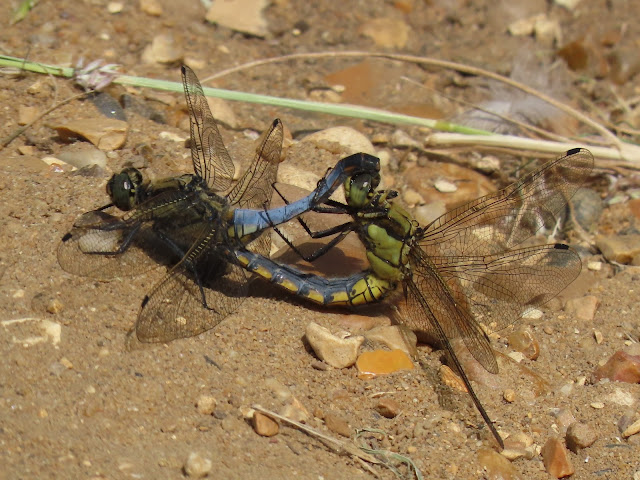
Pair of Black-tailed Skimmers

Dagenham Chase

I managed a respectable 14 visits this month. From the middle of the month there were clear signs of the autumn migration commencing with a rise in the number of Lapwings on The Slack (reaching 20 by the end) and the first returning Black-headed Gulls. The water level is severely low at the moment but they are proposing to start pumping water into it this week.

I spent a lot of time searching all the elm trees for White-letter Hairstreak but to no avail. Although there are a lot of elms, there's very few mature ones as the rest have succumbed to Dutch Elm Disease. 

Last year I saw a lot of damselflies on Crowfoot Marsh but haven't found any this year and I suspect it's because of the dogs that go into the water. If the dogs have been treated with a particularly toxic anti-tick/flea treatment it washes off in the water and kills off all the insects.

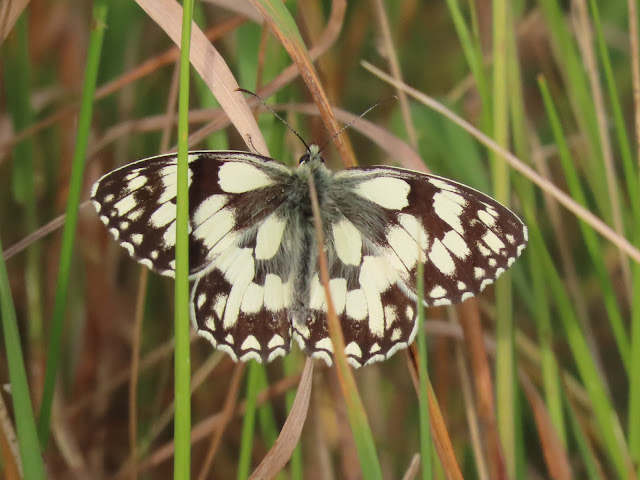
Despite all this I still managed to find a reasonable number of insects here this month. After finding the first Marbled Whites in the area last year, their colonisation continues and this year they've expanded their range out of Fels Field.

Black-and-Yellow Longhorn Beetle

Marbled White

Red Admiral

Ringlet

Rainham Marshes

I went to Rainham three times but only did the loop around the reserve once. I was particularly targeting dragons and damsels and managed six species, a fairly low total as it was a struggle to find any damselflies. I was especially pleased to find and photograph Norfolk Hawker as that was my main target for the day.

Norfolk Hawker

Ruddy Darter

Small Red-eyed Damselflies

I also had a wander around the country lanes outside of Rainham Village hoping to find some partridges. I didn't manage any but instead saw a Barn Owl which was probably bird of the month.

Goresbrook Park

This small park is a couple of minutes walk from my house but I rarely visit it as it's a bit hopeless. A river runs through it - The Gores - but is hideously choked with Himalayan Balsam. There's been some attempt to plant trees and shrubs but they're mostly dead which is a shame as it could be a nice place with a bit more effort. I had a wander round looking for butterflies, most of which were feeding on a Buddleia.

Comma

South London

I ventured south of the river a couple of times, first to Epsom Common to look for Black Hairstreak. It was just my second visit to this site, the first being many years ago to see a Little Bittern. It's a fairly easy journey on the train but there are some very specific instructions to follow to get to the hedge the hairstreaks live on. 

As we got there I saw one fly past and then never saw any more for the whole time we were searching. We met a few other people who were also searching but they hadn't found any although they had been seen earlier in the week. I'll give it another go next year. At least there were other butterflies and insects around and we got great views of White Admirals.
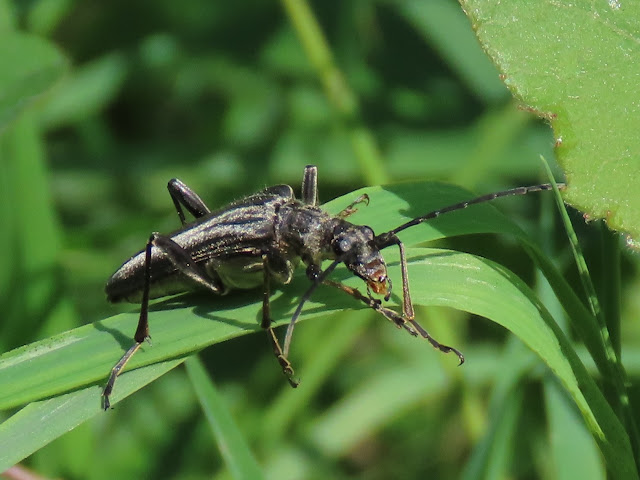
Variable Longhorn Beetle

White Admiral

The following week we went to Crossness where the Ruddy Shelduck was located on the foreshore. It was one of the hot days so we only walked part of the route and took a bus  back to Abbey Wood station.

Ruddy Shelduck

Small Red-eyed Damselflies

The dry summer has taken its toll on my garden and everything is looking like it belongs in the Atacama Desert. However, the few flowers that are thriving have been a boon for insects and I found a few Small Skippers on the lavender in my front garden and, best of all, a Bee Beetle in the back garden, a really stunning insect.

Bee Beetle


Monday, December 2, 2024

Andamans Part 2

Thursday 21st

Our 5.40 pick up had become standard now and we drove to a new area, pausing briefly for a flock of Daurian Starlings. In this patch of forest we added Small Minivet and Black-naped Monarch as well as getting better views of Andaman Shama. In a feeding flock there were plenty of Andaman Drongos and a few Andaman Treepies (Endemic #14) while in the distance there was a perched Andaman Serpent-Eagle (Endemic #15).


Andaman Woodpecker


Andaman Serpent-Eagle

Vernal Hanging-Parrot and Parakeet


The hotel had forgotten to provide packed breakfasts so we stopped for a much nicer hot breakfast in a little roadside café opposite the beach. While we were there a White-bellied Sea-Eagle soared over the bay.


White-bellied Sea-Eagle


We tried another marsh where a regular Amur Stonechat was still present and there was also a Dollarbird and the daily Brown Shrike. On the way back our driver found us a bright green Andaman Day Gecko.

Andaman Day Gecko

Forest flowers

After downtime and lunch we headed back out for the afternoon session, visiting a different wetland area. 


One of the hazards that make driving in India challenging - cows on the road

A mud and rubbish filled swamp held several waders including Wood and Curlew Sandpiper, Pacific Goldies and Pintail Snipe. We managed to find a Red-throated Pipit on the deck with several more Eastern Yellow Wagtails.

Scarlet Skimmer

Pintail Snipe feeding in a rubbish strewn swamp


Blue-tailed Bee-eaters

Grey-headed Swamphen

Both Yellow and Black Bitterns were added to the heron list and we also had our first terns of the trip with a small flock of Whiskered Terns hunting over the back lake. Two Jungle Crows flew over before it was time to go and stake out the next owl.

Black Bittern


White-throated Kingfisher

We parked up at the back of a school and waited for it to get dark and then an Andaman Masked Owl (Endemic #16) appeared on a ledge and remained perched there while we took our photos.

Andaman Masked Owl

Friday 22nd

Out again at 5.40 to the ferry. While we waited a few Pied Imperial Pigeons flew over the harbour to join a small roosting flock. After the short ferry crossing we stopped at a small lake where a single Eurasian Wigeon had appeared with a flock of Cotton Pygmy-Geese. A flyover raptor turned into our only Oriental Honey-Buzzard of the trip. We visited the same patch of forest as on our first morning.

Apart from a similar selection of birds we also saw a Mangrove Whistler, two Black Bazas and a large mixed flock of Andaman Treepies and Drongos. An obliging Andaman Cuckooshrike that loosely associated with this flock was new for those who missed the one earlier in the week. 

Andaman Cuckooshrike

After our packed breakfast we were whisked back down the road to the mangroves where a Ruddy Kingfisher had been located. Initially it was quite hard getting a view of it but we eventually got a clear view of it.

Ruddy Kingfisher

We drove on to the wetland area we visited on Wednesday. This time our luck was in and there was no human disturbance so we quickly found a group of Andaman Teal (Endemic #17). On the opposite lake a couple of Oriental Pratincoles sat on the mud. In the whole area we also saw Cinnamon and Yellow Bitterns and walking back I found a Dusky Warbler that decided to show itself.


Oriental Pratincoles

White-bellied Sea-Eagle

Andaman Teal

Grey-headed Swamphen

Brown Shrike

At the next wetland spot there was Chinese Pond-Heron, Purple Heron and Pheasant-tailed Jacana. We drove back to the hotel for lunch, seeing an Oriental Garden Lizard, appropriately enough in the hotel garden.

Oriental Garden Lizard

In the afternoon we left at 15.30 and went to the same rubbish-filled swamp as yesterday but there were no additional waders. We made a brief roadside stop for a flock of White-rumped Munias in a garden and stopped for coffee by the beach. Oddly enough there was what looked like a WW2 pillbox there. A few Pacific Reef-Egrets flew past and a Tibetan Sandplover was roosting on a near rock.

White-rumped Munia

2 Little Egrets = 1 Great Egret

Great Egret


Egret Fest: Medium, 2 Littles and Great

We drove a short distance to a scrubby area and barely had to wait for any length of time before an obliging Andaman Nightjar (Endemic #18) was watched perched in a tree. This was the last ‘easy’ endemic to see with only the Woodpigeon remaining so it only taken us four days to mop up. 

Andaman Nightjar

Saturday 23rd

An even earlier start as we wanted to get to a further forest at dawn so we left the hotel at 4.45. It was light by the time we got there and we slowly walked down the road scanning both sides of the forest for the mythical Andaman Woodpigeon. We saw a few similar looking Green Imperial Pigeons fly over but there was no sign of our quarry.

After another uninspiring packed breakfast there were a few more birds around and we saw Scarlet Minivet, Andaman Cuckoo-Dove, Drongo & Treepie. Flyovers included our first Forest Wagtail of the trip and a handful of Hill Mynas. With no sign of the woodpigeon we went back to some of the wetlands we’d already visited.

On the first lake there was a large flock of Andaman Teal where we’d seen none on previous visits. A quick count got up to 148 – there were a few obvious fairly plain juveniles and a mix of adults from those with just a white eye-ring to some having an almost entire white head.

Andaman Teal

Slender Skimmer

Yellow-striped Flutterer

We were looking for a Red-necked Stint that was known to be in the area but couldn’t find that either, however we did add Broad-billed Sandpiper and Temminck’s Stint to the trip list. There was the usual selection of Pintail & Common Snipe, Redshank, Wood & Curlew Sands and a few Long-toed Stints. We returned to the hotel late morning.

Striated Heron

Wood Sandpiper

Common Redshank

In the afternoon we went out at 2.45pm and headed to some different wetlands. A juvenile Purple Heron was on one marsh and a Yellow Bittern was on another with a massed flock of 78 Grey-headed Swamphens. Three Whiskered Terns hawked over the water and a distant Stork-billed Kingfisher was seen through the scope. 

Grey Pansy


Whiskered Tern

We wandered over some grassland where a drove of pigs was being rounded up by a guy on a motorbike. Unfortunately they flushed a bunting that our guide had just found. We tried to lure a Slaty-breasted Rail out from the marsh but it wasn’t interested.

Eastern Yellow Wagtail

House Crow

As dusk was approaching we drove the short distance to our owl spot. On arrival it was calling but we had other business first and were soon watching a superb Orange-headed Thrush feeding out in the open. 

Orange-headed Thrush

The owl wasn’t so obliging and remained hidden in a dense clump of leaves while calling. It flew over the road but immediately hid again. Luckily one of our eagle-eyed drivers had managed to locate another one and we were soon enjoying great views of an Oriental Scops-Owl. This is the resident race so may be split into a separate species in the future for yet another Andaman endemic.


Oriental Scops-Owl

Morocco

The second leg of our Corsica & North Morocco trip with Zoothera Birding began in Casablanca. We landed at 9.30 pm local time, now the s...